How pharmaceutical companies can strengthen their oncology offering through collaboration with QuestPrehab’s scalable digital prehabilitation solution.
Optimised cancer patients respond better to treatment
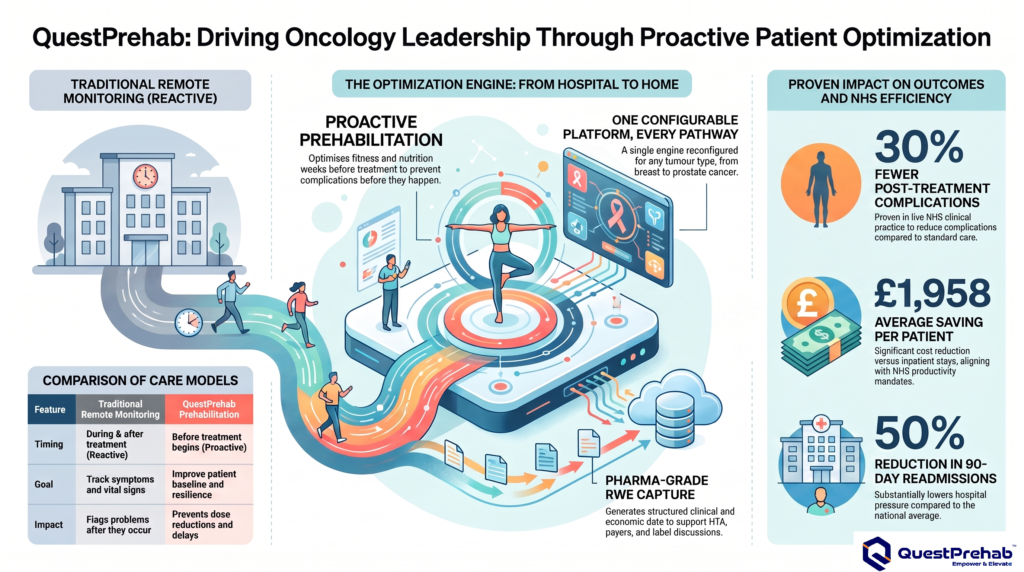
QuestPrehab, digital prehabilitation, offers a differentiated, scalable, and home-based prehabilitation platform designed to integrate with pharmaceutical oncology portfolios. As clinical data alone no longer suffices to differentiate competing oncology medicines, the “service layer” has become the primary factor for NHS clients in determining pathway selection. QuestPrehab shifts the care paradigm from reactive remote monitoring to proactive patient optimisation before treatment begins. By improving patient fitness, nutrition, and psychological resilience through a 2–6 week digital multimodal program, the platform aims to maximise drug efficacy and minimise treatment dropouts. Evidence from live NHS clinical practice demonstrates a 30% reduction in post-treatment complications and a 50% reduction in 90-day readmissions. For pharmaceutical partners, QuestPrehab provides a “prove once, scale everywhere” model, allowing a single configurable engine to support multiple indications across an entire oncology portfolio with minimal incremental cost.
1. The Strategic Imperative for Oncology Partnerships
In the current oncology landscape, world-class leadership requires more than a portfolio of medicines. Pharmaceutical companies must now provide comprehensive service packages to remain competitive.
- Market Saturation: In high-value areas like hormone-driven and GU cancers, competing medicines often share similar efficacy and safety profiles. Clinical data is no longer the sole differentiator.
- The Service Differentiator: NHS clients increasingly prioritise the “service wrapped around the drug.” The manufacturer that offers the most compelling, outcome-improving service package is most likely to win the pathway.
- Alignment with NHS Reform: The NHS 10-Year Health Plan identifies “hospital to home” as a defining shift. Backed by £29bn in committed reform funding, the NHS is mandating a ~4% productivity improvement and an expansion of virtual ward occupancy (required to be >80%).
- Value-Added Shift: While existing pharmaceutical home-care partners focus on reactive remote monitoring during and after treatment, QuestPrehab offers proactive optimisation before treatment starts, changing the patient’s baseline condition.
Comparison: Remote Monitoring vs. QuestPrehab Prehabilitation
Feature,Reactive Remote Monitoring,Proactive Prehabilitation (QuestPrehab)
Timing,During and after treatment,Before treatment begins (2–6 week window)
Focus,Tracks symptoms and flags problems,”Optimises fitness, nutrition, and resilience”
Patient State,Patient enters treatment in their current condition,Patient arrives in the strongest possible condition
Impact,Acts as a safety net; doesn’t change baseline,Actively improves baseline to help the drug succeed
2. The QuestPrehab Platform: Technical and Functional Overview
QuestPrehab is defined as a platform rather than a standalone app. It is a configurable engine that provides clinical oversight and generates high-fidelity data.
The Five Evidence-Based Modules
Delivered concurrently via a mobile app (iOS and Android), the program personalises five core modules to each patient’s clinical profile and comorbidities:
- Exercise Training: Prehabilitation to build physical reserve.
- Nutritional Optimisation: Guideline-based support (targeting 1.5g/kg protein).
- Mental Wellbeing: Validated screening, mindfulness, and support.
- Patient Education: Condition-specific content to build readiness.
- Breathing Exercises: Respiratory conditioning.
Platform Infrastructure and Compliance
- Clinician Oversight: A real-time dashboard provides referring clinicians with a live view of engagement and automated “red-flag” alerts.
- Data and Evidence Layer: The platform captures structured clinical, behavioral, and economic data at 6 and 12 months for Real-World Evidence (RWE).
- Regulatory Status: Classified as Health Software; UKCA marked; HIPAA and UK GDPR-aligned; NHS DTAC compliant and registered with NHS Data Security and Protection Tool Kit (DSPT).
3. Clinical and Economic Impact
QuestPrehab utilises an “Optimisation Equation” to transform unconditioned patients, who often face dose reductions and treatment delays, into optimised candidates.
Key Performance Indicators (NHS Evaluation)
- 30% Reduction in Complications: Compared to standard care.
- 50% Reduction in 90-day Readmissions: Compared to the national average.
- 30% Potential Reduction in Treatment Dropouts: Up to 25% of oncology patients modify or discontinue treatment due to side effects; QuestPrehab enables full-course completion.
- Reduced Length of Stay: A 1–4 day reduction in hospital stays.
- Cost Savings: An average saving of £1,958 per patient compared to an inpatient stay, with £1.5M in documented savings across deployed sites.
Patient and Clinician Acceptance
- High Satisfaction: 98% satisfaction rate among both patients and clinicians.
- Participation: 81% program participation rate (based on a breast cancer study).
- Reach: Over 2,800 patients optimised to date in live clinical practice.
4. Scalability Across the Oncology Portfolio
A primary value proposition for pharmaceutical partners is the platform’s ability to be configured rather than rebuilt for new indications.
One Engine, Multiple Pathways
The modular design allows for rapid rollout across various tumor groups:
- Breast Cancer: Neoadjuvant and surgical pathways.
- Prostate / GU: Systemic therapy pathways.
- Bladder / Urothelial: Perioperative pathways.
- Gynaecological: Surgical and neoadjuvant pathways (Ovarian, Endometrial).
- Colorectal & Upper GI: Surgical and neoadjuvant chemotherapy pathways.
Commercial Advantages for Pharmaceutical Partners
- Portfolio-Wide Asset: One platform investment supports every product line, turning patient support from a per-drug cost into a scalable asset.
- Maximised Drug Efficacy: Fitter patients can better tolerate prescribed therapies, ensuring treatment integrity.
- High-Quality RWE: Captures granular, continuous phenotyping data to inform clinical trial design, patient stratification, and post-market safety dossiers.
- Brand Loyalty: Transforms the care pathway by delivering a patient-centric support model directly to the home, building resilience and brand differentiation.